
The science
The science
What is proven, what is reasonable and what is hype. On sauna, heat and the body - both ways.
Last reviewed 12 September 2026 · Sources checked 12 September 2026
See all sources
Summary
What we know - in short
Five answers, one per topic. The letter shows how strong the evidence is. Want to go deeper? The full research sits further down the page.
- B
Sauna & heart: regular sauna bathing is linked to better heart health and longer life in Finnish studies - correlation, not proven cause.
- B
Heat & fertility: regular sauna use temporarily lowers sperm count and motility. If you are trying to conceive, allow three months of recovery.
- C/D
Active cooling: reasonable to keep the scrotum cool while the rest of the body is hot. Whether it protects sperm has not been shown.
- A
Sweat: over 99 percent water - its job is to cool you. The liver and kidneys do the cleaning.
- A/B
Hydration & alcohol: replace 1.25–1.5 litres per kilo lost, with a little salt. Alcohol does not belong in the sauna.
How to read this page
We label everything with a letter:
- A – Strong evidence. Randomised trials, meta-analyses or broad medical consensus.
- B – Moderate evidence. Large population studies (correlation, not proven cause) or small but controlled experiments.
- C – Weak evidence. Small or old studies, plausible mechanisms, tradition.
- D – Anecdote. One person measuring themselves. Interesting, not proof.
And with a traffic light for what we ourselves say: green we say plainly, amber we say with a caveat, red we do not say.
Sauna and health - the upside
BAlmost everything we know about sauna and long-term health comes from one Finnish population study: around 2,300 middle-aged men from eastern Finland, examined in the 1980s and followed for more than 20 years (the KIHD cohort, led by cardiologist Jari Laukkanen).
Go deeper into the research
Compared with men who used the sauna once a week, those who went 4–7 times a week had:
- 63% lower risk of sudden cardiac death and 40% lower all-cause mortality (Laukkanen et al. 2015, JAMA Internal Medicine).
- Around 60% lower risk of stroke, in a follow-up that also included women (Kunutsor et al. 2018, Neurology).
- Sessions longer than 19 minutes were linked to lower risk than sessions under 11 minutes.
How to read that: it is correlation, not proven cause. Healthy people use the sauna more, and sauna habits were measured once, in the 1980s. Critics at McGill University point out that the same cohort has been published in many slices. But the pattern is consistent, dose-dependent and biologically plausible - heart rate rises to 120–150 beats per minute, up to 70 percent of blood circulates via the skin, and blood pressure and arterial stiffness drop after a session.
Other findings with research behind them:
- Skin. Regular sauna bathers had better-hydrated skin and a barrier that recovered faster after heat (Kowatzki et al. 2008, Dermatology, 41 people).
- Mood. Swedish sauna bathers rate themselves happier than others (Luleå University of Technology, 2024) - survey data, not an experiment.
- Systematic review. 40 studies with 3,855 participants found sauna safe for most people and favourable for cardiovascular measures, blood pressure and quality of life (Hussain & Cohen 2018).
We can say this
Regular sauna bathing is linked to better heart health and longer life in Finnish studies. That is correlation, not proof - but they are strong correlations.
We do not say this
“Sauna extends your life”, “sauna cures”, “sauna cleanses the body”.
Section sources: JAMA Intern Med 2015 · Neurology 2018 · Mayo Clinic Proceedings 2018 · Hussain & Cohen 2018 · Kowatzki 2008 · Läkartidningen 2018 · McGill OSS 2021 (critique). Links under Sources.
Heat and fertility - the risks
BThis is the part of sauna culture that rarely gets mentioned. We mention it, because it is why the company exists.
Go deeper into the research
The physiology (A). The testicles need to sit at roughly 34 degrees - a few degrees below the rest of the body. That is why they hang outside. The body forms about 100 million sperm a day, and a single sperm takes roughly three months to form and mature. The Swedish health service 1177 states plainly that tight underwear or daily hot baths can stall production - and that it starts again when you stop.
The central study (B). Ten healthy Italian men used a sauna twice a week, 15 minutes at 80–90 degrees, for three months. Sperm count and motility dropped sharply - more than halved according to several summaries. Six months after they stopped, everything was normal again (Garolla et al. 2013, Human Reproduction). Hormones were unaffected.
What that means in practice:
- The effect is real, dose-dependent and temporary. If you go once a week and are not planning children, there is nothing to worry about.
- The effect lags. What a semen sample shows today reflects how you lived two to three months ago.
- Count on three months for recovery - a full sperm cycle. The Garolla study saw normal values after six months.
Other heat sources that have been studied:
- Tight underwear. In the largest study - 656 men at a fertility clinic - boxer wearers had 25% higher sperm concentration and 17% higher count (Mínguez-Alarcón et al. 2018). A 2026 review notes that no study has shown an effect on actual pregnancies: loose fit is a supportive low-risk measure, not a treatment.
- Heatwaves and prolonged sitting raise temperature. A study of 818 men in Singapore found 46% higher odds of low sperm count after 90 days with outdoor temperatures above 29.8 degrees.
- Hot tubs and hot baths. Clinics such as Mayo Clinic, Nordic IVF and Kry generally advise against them while you are trying to conceive.
What Swedish experts say. Endocrinology professor Mikael Lehtihet argues that heat and cooling matter “only for men who are borderline and actively trying to conceive”. Andrologists Elenkov, Lundberg Giwercman and Giwercman write in Läkartidningen that there is “still no evidence that lifestyle changes lead to improved fertility”. We think both deserve quoting.
We can say this
Regular sauna use temporarily lowers sperm count and motility. If you are trying to conceive - avoid sauna and hot baths for three months, or keep the scrotum cool.
We do not say this
“Sauna makes you sterile”, “our products protect your sperm”.
Sources: 1177 · Garolla 2013 · Mínguez-Alarcón 2018 (ESHRE) · Transl Androl Urol 2026 · Euronews 2024 · Läkartidningen 2022 · Metro Mode 2026 · Mayo Clinic · Nordic IVF · Kry.
Cooling - what we know and do not know
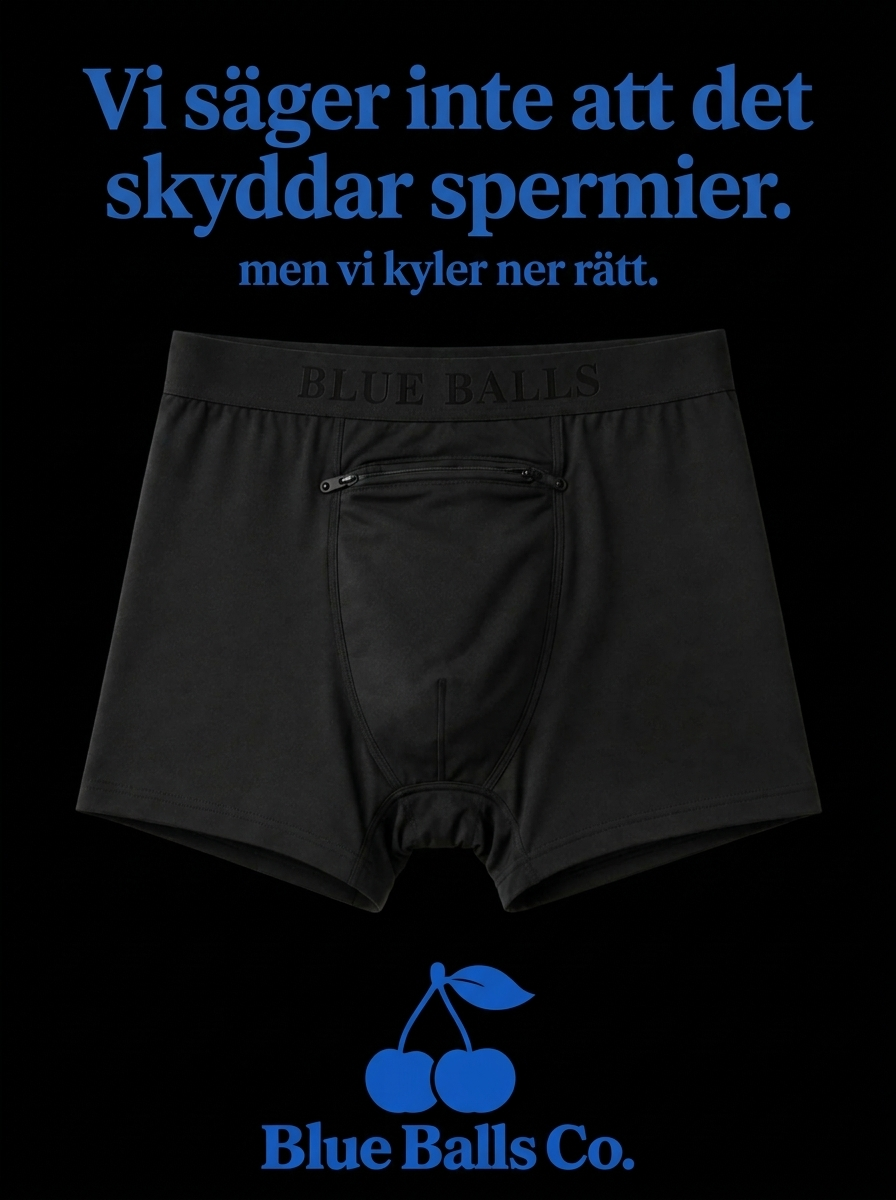
C/DAvoiding heat helps - that is well established (B). Actively cooling is a different question.
Go deeper into the research
- The 1980s. Urologist Adrian Zorgniotti had 90 infertile men wear a scrotal cooling device. About two thirds improved their samples (Zorgniotti et al. 1986, Journal of Urology). Small, old and weakly controlled - but it is the origin of the whole idea (C).
- 2025. Bryan Johnson measured himself: daily 93-degree sauna without ice roughly halved his motile sperm count in two weeks, and with ice the values recovered. His own comment: “Was it the sauna? Sauna + ice? Ice only? We don’t know.” (D)
- What urologists say. Michael Eisenberg (Stanford) on Huberman Lab: a cold pack during a sauna session is reasonable - but insulate it from the skin, cold injury there is real. Sperm testing company Legacy summarises the state of things as “no evidence to say that icing testicles will be of benefit”.
- Cold and testosterone. There is no evidence that cold raises testosterone. Full stop.
No study has tested a cold pack in the sauna on healthy men. We sell cool and comfort. Whether it does anything more, nobody knows yet - and we will not pretend otherwise.
With a caveat
It is reasonable to keep the scrotum cool while the rest of the body sits at 90 degrees. Whether that protects sperm has not been shown.
We do not say this
“Cooling improves fertility”, “raises testosterone”, “protects your sperm in the sauna”.
Sources: Zorgniotti 1986 · Blueprint blog (n=1) · Huberman Lab × Eisenberg · Legacy · Vice 2022.
Sweat and sweating things out - why we skip the buzzword
ABryan Johnson says his sauna protocol “annihilates toxins”. It does not, and that is easy to show.
Go deeper into the research
- Sweat is more than 99 percent water, with salts, lactate and urea. Its job is cooling (Baker 2019; 1177).
- Researchers who did the maths found that even heavy sweating removes roughly 0.02 percent of the environmental pollutants we take in daily - 0.04 percent at maximum effort (Imbeault et al. 2018).
- PFAS, so-called forever chemicals, are not excreted in sweat - shown even by the group most positive about sweat as an excretion route (Genuis et al. 2013).
- Microplastics are particles and cannot pass through sweat glands. The measurement methods behind the headlines have also been questioned by chemists.
- The largest systematic review of sauna bathing calls the evidence here “scant and incomplete” (Hussain & Cohen 2018). Fact-checker Science Feedback: Unsupported.
- Bryan Johnson’s own percentages are one person’s spot samples of substances that leave the body within hours, while he also changed his water filter and cutting board.
Why we still say “shower after the sauna”: hygiene, cooling down, and rinsing off salt and sweat that dry out the skin. Not because anything is reabsorbed - no study supports that.
And the scrub? Heat softens the outermost skin layer so dead cells come away more easily - that is common to Finnish birch whisks, Turkish kese and Korean seshin. The dermatology association AAD says: gently, about once a week, never on irritated skin, moisturise afterwards. That is all it does - and it is enough.
We can say this
The liver and kidneys do the cleaning. The sauna is for the heart, the skin and the head.
We do not say this
“Detox”, “cleanses the body”, “sweats out toxins”, “removes microplastics”.
Sources: Baker 2019 · Imbeault 2018 · Genuis 2013 · Hussain & Cohen 2018 · Science Feedback 2024 · McGill OSS · AAD.
Fluid, salt and alcohol
A/BTwo or three rounds cost half a litre to a litre of sweat. Replace 1.25–1.5 litres per kilo lost, with a little salt in it - large volumes of plain water dilute your blood. Salt loss varies tenfold between people, so learn your own. And alcohol does not belong in the sauna: it is the one real danger.
Go deeper into the research
- A normal session of two or three rounds costs 0.5–1 litre of sweat. Weigh yourself before and after: one kilo down is one litre.
- Sweat salt content varies tenfold between people - 200 to 2,300 mg sodium per litre, averaging around 950 mg (Precision Hydration, 30,000 tests). White salt marks on your clothes and stinging eyes mean you are a salty sweater.
- Replace 1.25–1.5 litres per kilo lost over the following hours, with a little salt in it. Large volumes of plain water dilute your blood. Rehydration salts, an electrolyte powder or a couple of pinches of salt per litre all work.
- Swedes already eat 8–11 grams of salt a day against a recommended 6 (Livsmedelsverket). You do not need electrolyte powder day to day - but after a hard session an extra gram of sodium is reasonable.
- Alcohol is the one real danger. The vast majority of sauna deaths in Finland involve alcohol. Drink after the sauna, not in it.
Sources: Precision Hydration · 1177 · Livsmedelsverket 2023 · The Finnish Sauna Society · Läkartidningen 2018.
Questions about the research
Sources
Missing a study? Write to us - we update the page when the research updates.
Bastu & hälsa
- Open source
Laukkanen T. et al. (2015)
JAMA Internal Medicine - Association Between Sauna Bathing and Fatal Cardiovascular and All-Cause Mortality Events
- Open source
Kunutsor S.K. et al. (2018)
Neurology - Bastu och stroke
- Open source
Laukkanen J.A., Laukkanen T., Kunutsor S.K. (2018)
Mayo Clinic Proceedings - Cardiovascular and Other Health Benefits of Sauna Bathing: A Review of the Evidence
- Open source
Hussain J., Cohen M. (2018)
Evid Based Complement Alternat Med - Clinical Effects of Regular Dry Sauna Bathing: A Systematic Review
- Open source
Kowatzki D. et al. (2008)
Dermatology - Effect of Regular Sauna on Epidermal Barrier Function
- Open source
Olsson S.B. (2018)
Läkartidningen - Bastubad kan vara bra vid ett antal sjukdomar – men fler studier krävs
- Open source
Jarry J. (2021)
McGill Office for Science and Society - Sweating Out the Hype Over the Finnish Sauna
- Open source
Hägglund H. (2025)
Forskning & Framsteg - Skriv ut bastubad på recept
- Open source
SVT (2024)
SVT Nyheter - Ny forskning: bastubadare lyckligare än andra
- Open source
Uppsala universitet (2020)
Uppsala universitet - Många hälsofördelar med bastubad (med kontraindikationer)
- Open source
Finska Bastusällskapet (-)
sauna.fi - Sauna and health effects
Värme & fertilitet
- Open source
1177 Vårdguiden (-)
1177 - Så fungerar det manliga könsorganet
- Open source
Garolla A. et al. (2013)
Human Reproduction - Seminal and molecular evidence that sauna exposure affects human spermatogenesis
- Open source
Mínguez-Alarcón L. et al. (2018)
Human Reproduction / ESHRE - Underkläder och testikelfunktion
- Open source
Narrativ översikt (2026)
Translational Andrology and Urology - Garment fit, scrotal thermoregulation, and male fertility outcomes
- Open source
Euronews (2024)
Euronews - Sperm count, concentration and speed suffer under extreme heat
- Open source
Elenkov A., Lundberg Giwercman Y., Giwercman A. (2022)
Läkartidningen - Andrologisk undersökning bör ingå i infertilitetsutredningen
- Open source
Metro Mode (2026)
Metro Mode - Kan bastubad förbättra mäns fertilitet? (prof. Mikael Lehtihet)
- Open source
Mayo Clinic (-)
Mayo Clinic - Healthy sperm: improving your fertility
- Open source
Nordic IVF (-)
Nordic IVF - Mer spermier
- Open source
Kry (-)
Kry - Nio livsstilsfaktorer som påverkar manlig fertilitet
- Open source
Forskning & Framsteg (2020)
Forskning & Framsteg - Tillskott gav inte bättre spermier (2 372 par)
- Open source
Legacy (-)
Legacy - Saunas, hot tubs, and sperm production
Kylning
- Open source
Zorgniotti A.W., Cohen M.S., Sealfon A.I. (1986)
Journal of Urology - Chronic scrotal hypothermia: results in 90 infertile couples
- Open source
Johnson B. (2026)
Blueprint - My #1 Longevity Protocol of 2025
- Open source
Huberman Lab × Michael Eisenberg (2023)
Huberman Lab - Om värme, kylning och pungen
- Open source
Legacy (2025)
Legacy - Can icing your testicles improve fertility, testosterone, or sperm count?
- Open source
Vice (2022)
Vice - Why Are People Icing Their Testicles?
Svett & utsvettning
- Open source
Baker L.B. (2019)
Temperature - Physiology of sweat gland function
- Open source
Imbeault P., Ravanelli N., Chevrier J. (2018)
Environment International - Can POPs be substantially popped out through sweat?
- Open source
Genuis S.J. et al. (2013)
ISRN Toxicology - PFAS och PCB i svett
- Open source
Science Feedback (2024)
Science Feedback - Lack of reliable evidence supporting the claim that sauna bathing is an effective way to “detox”
- Open source
Schwarcz J. (-)
McGill OSS - Sweating like a pig
- Open source
1177 (-)
1177 - Överdriven svettning (svettens funktion)
- Open source
AAD (-)
American Academy of Dermatology - How to safely exfoliate at home
- Open source
Finska Bastusällskapet (-)
sauna.fi - Quality guidelines for sauna whisks
Vätska
- Open source
Precision Fuel & Hydration (-)
Precision Hydration - How to estimate how much sodium you lose in your sweat
- Open source
1177 (-)
1177 - Vätskebrist och uttorkning
- Open source
Livsmedelsverket (2023)
Livsmedelsverket - Hur mycket salt äter vi i Sverige?
Blue Balls Co. sells sauna textiles and accessories for comfort. Our products are not medical devices and we make no claims about effects on fertility, semen quality or hormones. The content on this page is a summary of published research and does not replace medical advice - if you have questions about your reproductive health, talk to a clinician. We update the page when the research does. Last reviewed: 12 September 2026.
Made for the sauna floor
The research explains why we build what we build. It is not a claim that a product makes you healthier.